

Today we are going to Discuss knowledge process outsourcing (KPO) is a contract of a specific business function or service to the external service provider. Knowledge process outsourcing (KPO) usually, work is knowledge-based and it requires special skills and expertise. Knowledge process outsourcing (KPO) KPO is one of the most in the broad outsourcing trend, which has seen companies contracting various business functions in recent years to reduce costs and improve efficiency. Knowledge process outsourcing (KPO) As a result, you can focus on running your business while leaving staffing for experts. Knowledge process outsourcing (KPO) so if you are considering expanding your business internationally, consider the KPO to reduce the risk and maximize the opportunity.
What is KPO (Knowledge Process Outsourcing)?

Knowledge process outsourcing (KPO) is an outsourcing of information-localized business activities. KPO involves working for individuals who usually face degrees and expertise in a particular field. Information-related work can be done by workers in a separate company or by a subsidiary of the same organization. Auxiliary or help to save other resources can be in the same country or offshore place.
Understanding of Knowledge process Outsourcing
Knowledge process outsourcing is the purposeful allocation of relatively high-level functions, involving specialized knowledge or problem-solving, to an external organization or third party with a high degree of subject matter expertise, often within the company’s own domain.
KPO is distinct from business process outsourcing (BPO), which involves outsourcing labor and other operational tasks to a third party in order to save money. Although KPO is a subset of BPO, KPO involves far more specific, analytical and knowledge-based work.
Types of KPO Services
- A few common examples of KPO outsourcing domains include:
- Financial consultant
- Research & Development (R&D)
- Business Operations (Management Consultancy)
- Technical analysis
- Investing
- The legal
- Medical and health
- Data Analysis & Interpretation.
Advantages of KPO
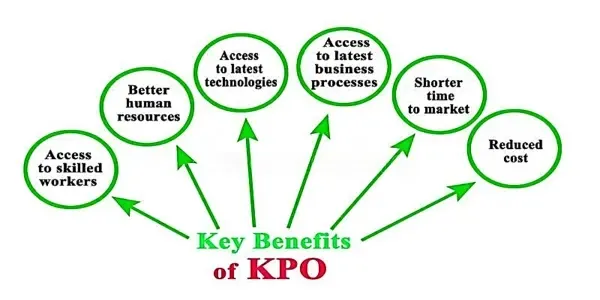
Cost-effectiveness
One of the biggest advantages of KPO is the cost advantage. The company is not required to set up any infrastructure or bear any operational or operational costs. And it becomes cost-effective, getting specialized services at a fraction of the cost.
Access to the Best Talent
KPOs provide a company with the best, most knowledgeable, and skilled professionals available in the global talent pool. And if the KPO is in a developing country like India or the Philippines, then the cost of such talent is relatively less.
Focus
Outsourcing certain processes allow the company to focus on its core functions. KPO handles peripheral tasks, and the company can better focus on its core operations and improve its efficiency and results.
Better use of resources
If the company outsources a process that is not at the core of their business strategy, it can use the resources it saves in better places. Say a company outsources its supply chain management. The resources saved on this can then be used for streamlining the manufacturing process, R&D activities, better marketing, etc.
Knowledge Process outsourcing VS. Business Process Outsourcing
Again, while KPO is a subset of BPO, the two are quite different in many ways.
The terms KPO and BPO are used for two different reasons.
With BPO, the main focus is usually on maintaining an operational status quo – and spending just as little time, money, and other resources to do so. While implementing BPO enables teams to make more “big pic”.
Knowledge process outsourcing, however, is about developing your processes and allowing your business to reach the “next level” in a specific area. Rather than aiming to do with less, KPO implementers are looking to do more – even if it means making drastic changes to their current operations.
Risk of Knowledge Process outsourcing
- While knowledge process outsourcing can lead to incredible things for your business, it is not without its fair share of risks.
- Lack of operational control – One of the biggest risks you run when working with a KPO provider is delegating control of a core business function to a third party.
- This lack of control is a substantial risk when outsourcing surface-level business processes. When it comes to your high-level, knowledge-oriented processes, you need to be certain that your provider is taking things in the right direction.
- Data Security Issues – Providing a third-party organization with access to your company’s data and knowledge is always a risk for several reasons.
- You need to have confidence that your KPO provider will keep your data as secure as possible, and comply with compliance regulations whenever necessary. In some cases, their failure to do so can lead to legal problems and other problems for your business.
- Communication Barriers and Silos – The same barriers to communication that exist with business process outsourcing are prevalent here as well – and have been magnified to a great extent.
- These constraints include:
- Geographical constraints such as different time zones and operating hours
- Cultural barriers can lead to miscommunication and sending the wrong message.
Conclusion
KPO in India can result in huge cost savings and increased efficiency for the client. It can also leverage India’s vast knowledge base to perform a high level of skill- and decision-based services and tasks. But the potential KPO client should be aware that KPO presents several risks – particularly concerning controlling intellectual property and protecting sensitive data – that must be considered and addressed. However, these risks can be managed through due diligence, planning, and a well-drafted KPO contract that properly identifies and addresses risks and provides realistic and practical safeguards and enforcement mechanisms.
FAQs
1. What is a KPO?
2. Difference Between KPO Vs. BPO
3. What are the types of KPO?
4. What skills are required for an employee in KPO?
5. Is KPO a Call Center?
6. What is the maximum salary in KPO?
7. What is the eligibility for KPO?