

Business process outsourcing (BPO) is a method of subcontracting various functions related to a business to third party vendors.
Although BPO originally applied only to manufacturing entities, such as soft drink manufacturers who outsource large parts of their supply chain, BPO is now applied to the outsourcing of a variety of products and services.
What is a BPO (Business process outsourcing)?
Business Process Outsourcing (BPO) is a business practice in which an organization contracts with an external service provider to perform an essential business function or function.
An organization typically contracts with another business for such services when it has identified a process that, although necessary to its operations, is not part of its core value proposition. This step requires a good understanding of processes within the organization and strong business process management. Because these commodity processes generally do not distinguish one organization from another, enterprise executives often determine that they have little value in their own employees’ performance.
BPO is used for what?
Organizations engage in business process outsourcing for two main areas of function: back-office functions and front-office functions.
Back-office functions sometimes referred to as internal business functions include support operations including accounting, information technology (IT) services, human resources (HR), quality assurance, and payment processing.
Front-office functions are the processes and business operations that relate to or serve existing and potential customers, such as customer relationship services, marketing, and sales.
Processes that are typically outsourced include the following:
- Payroll & Accounting
- Admin
- Customer service
- IT Management and Services
- Production
- The Marketing
- The research
- The sale
- Shipping and logistics
How BPO Works?
Enterprise executives choose to outsource a business process for a number of reasons. Those reasons vary depending on the type, age and size of the organization, as well as market forces and economic conditions. An established company may choose to outsource a task it was performing after determining that a third-party service provider can perform the task better or cheaper. Management experts advise enterprise executives to identify functions that can be outsourced and then determine whether it makes sense to transfer that function to an outsourcing provider. If so, the organization must go through the process of not only identifying the best vendor for the job, but also shifting the job from in-house to an external provider.
What are the advantages of BPO?
The benefits of BPO commonly cited by proponents include the following
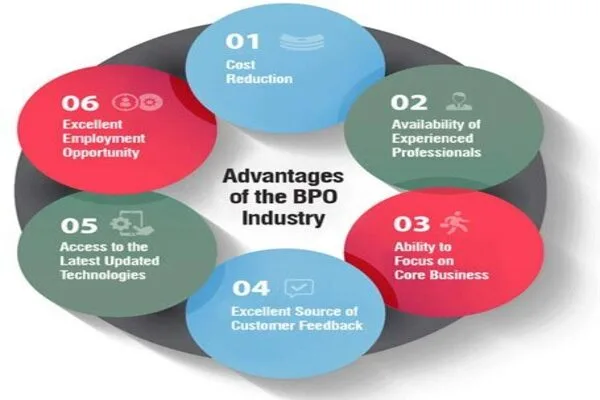
Financial gain
BPO providers may often perform a business process at a lower cost or save the company money in other ways, such as in tax savings.
Greater flexibility
BPO contracts can offer the ability to modify an outsourced business process, enabling companies to respond more quickly to changing market dynamics.
Increase in a competitive advantage
BPO enables an organization to focus most of its resources on the operations that differentiate it in the market.
High quality and superior performance
Because business processes are their core business, BPO providers are well-positioned to get the job done with greater accuracy, efficiency, and speed.
Access to innovations in the business process
BPO providers are more likely to keep abreast of advances in the process areas in which they specialize. This means they are more likely to invest in new technologies such as automation, which can improve the speed, cost, and quality of work.
Extended coverage
Organizations that require 24/7 call center operations can often achieve that capability quickly by contracting with a BPO company that, with round-the-clock capabilities and multiple geographic locations, is a follow-the-sun business. Enables the model.
What Are The Risks Of BPO?
Security Breach
The technology relationship between the hiring company and the BPO provider creates another point of entry for bad actors, as organizations are often required to share sensitive and regulated data with their service providers.
Regulatory compliance requirements
An organization’s regulatory requirements extend to outsourced work as well, so it must ensure that the vendors appointed by it are compliant with the laws that the organization must comply with and that the vendors comply with those regulations. Which governs the outsourced work of the organization.
Unexpected or high costs
Organizations may underestimate the amount of work to be done, which may result in higher costs than anticipated.
Relationship Challenges
Organizations may face communication problems with their outsourced providers, or they may find that there are cultural barriers.
Excessive reliance on an external provider
An organization that outsources a task or service is tied to a partner that performs the work. The organization must manage that relationship to ensure that critical objectives are met at the agreed cost.
Increased potential for disruption
An organization must monitor for issues that could disrupt or permanently terminate the relationship with an outsourced provider. These include financial or workplace problems, geopolitical instability, natural disasters, or changes in economic conditions at the outsourced provider.
What are the various types of BPO?
BPO is often divided into the following types depending on the location of the service provider:
- Offshore outsourcing occurs when an organization contracts with a company in a foreign country for services to be provided.
- Onshore outsourcing, or domestic outsourcing, occurs when an organization contracts for services to be provided by a company that operates in the same country as the recruiting organization.
- Proximity outsourcing occurs when an organization contracts for services to be provided by companies located in neighboring countries.
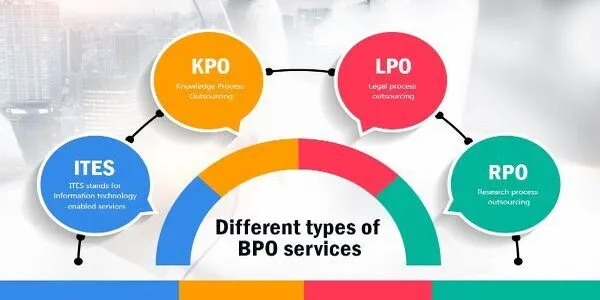
- KPO, LPO, and RPO
- Business process outsourcing is sometimes classified by the types of services being provided; The following three categories are commonly cited:
- Knowledge Process Outsourcing (KPO) – is when an outsourced service provider is hired not only for its ability to perform a particular business process or task but also to provide expertise around it.
- Legal Process Outsourcing (LPO) is a type of KPO that is specific to legal services – these range from drafting legal documents and conducting legal research to providing advice.
- Research Process Outsourcing (RPO) – another type of KPO – refers to research and analysis functions Biotech companies, investment firms and marketing agencies are among the types of organizations in RPOs for services.
Understanding of business process outsourcing
Many businesses, from small startups to large companies, choose to outsource processes because new and innovative services are increasingly available in today’s changing, highly competitive business environment.
Broadly speaking, companies adopt BPO practices in two main areas of back-office and front-office operations. Back office BPO refers to a company that outsources its core business support operations such as accounting, payment processing, IT services, human resources, regulatory compliance, and quality assurance to External professionals who ensure the smooth running of the business.
In contrast, front office BPO functions usually include customer-related services such as technical support, sales, and marketing.
How to select a BPO provider
Enterprise executives must select BPO providers that may support their business objectives, as well as help them be more agile, flexible and innovative, and ultimately more competitive. They should also consider how well the provider may deliver on those other points, evaluating each provider to determine if it has the following:
Adequate understanding of the business and industry of the organization
Ability to meet current needs, as well as scale to meet future needs;
understanding and ability to meet compliance and regulatory requirements as well as data privacy requirements;
To demonstrate the reporting metrics it is delivering on contractual standards; And
Geographical location to meet business requirements and regulatory requirements.
Conclusion
In the end, the use of business process outsourcing is a real growth lever for the company: low cost, flexibility, access to skills that it does not have, time savings and productivity … But it has to be thought through. Intercultural risk, the threat of extended deadlines, or the loss of control over the outsourced activity are all disadvantages that must be taken into account. Disadvantages which however can be anticipated in a partner given the geographic proximity of its decision center.
FAQs
1. What is BPO (Business process outsource)?
2. What exactly does BPO do?
3. Why we should hire you in BPO?
4. Is BPO job a good job?
5. Which skill is the most important for BPO job?
6. How has BPO changed the world today?
7. Why BPO Services Are More Successful?